Isn’t technology great? We walk in the door and our devices sync across platforms like magic. By the time we’ve showered, kudos and comments are already waiting.
Amazing.
But that convenience created a new problem.
Because when everything uploads automatically, it becomes easy to assume the data tells the whole story. Athletes stop paying attention to subjective feedback, and the habit of reporting how the workout actually felt begins to disappear.
Luckily, TrainingPeaks has a robust pre- and post-activity comment system, one of my most overlooked yet effective tools. Like Einstein said, “Genius exists in simplicity.”
As both a coach and an athlete, I see post-workout comments as one of the most valuable and underused tools.
What Are Post-Workout Comments?
They’re simple. A few notes about:
- how the session felt
- what influenced it
- what surprised you
- what might need to change next time
Nothing fancy. Just context.
Why Data Alone Isn’t Enough
There was a time when files didn’t always download cleanly. Platforms were clunky. Sometimes the data just didn’t exist. So athletes who wanted to improve wrote things down.
I still have handwritten journals from my early years: sets, reps, weather, who I trained with, what I ate, how work felt later in the day.
Without power or pace files to lean on, reflection had to speak louder. And because of that, athletes developed a sharper sense of effort and progression.
Reflection Builds Better Athletes
There’s something powerful about pausing for a minute after training and asking, what really happened out there?
It’s similar to journaling or meditation. It quiets the noise. It encourages honesty. And over time, patterns emerge. Athletes start recognizing:
- when fatigue is creeping in
- what good preparation feels like
- how motivation rises and falls
- when they’re ready for more
That awareness is priceless. I’m not trying to build robots who execute workouts. I’m trying to build thinkers.
Comments Create a Living History
When athletes and coaches communicate inside the workout, a thread forms.
Later, we can revisit:
- what led to a breakthrough
- what contributed to a bad day
- what habits we should repeat
- which ones we should avoid
That historical insight becomes invaluable when planning the future.
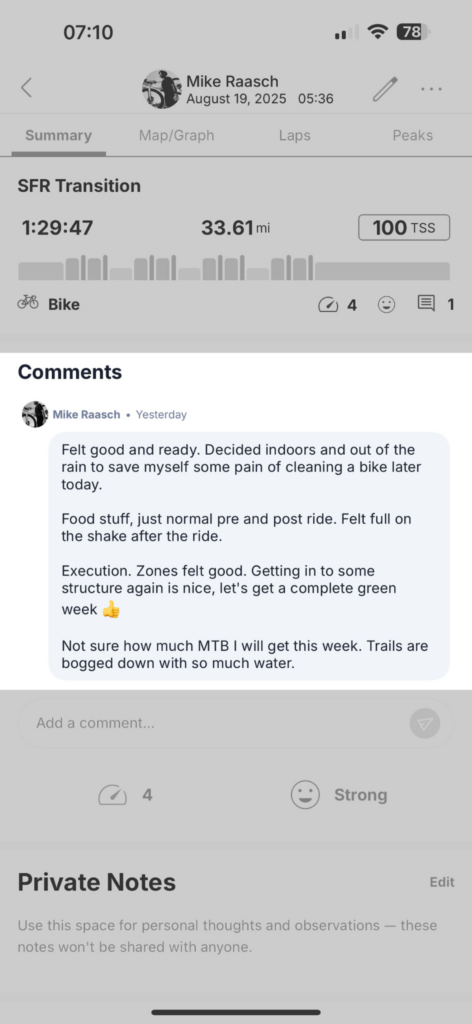
What Should You Include in Post-Workout Comments?
There are no strict rules, but useful reflections often mention:
- what you ate and drank
- how each portion of the workout felt
- your self-talk
- weather or environmental factors
- life stress
- motivation before starting
- energy once you got moving
- anything unusual that influenced performance
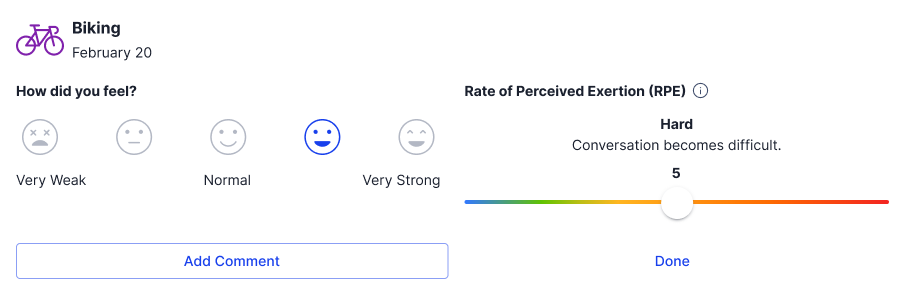
Honesty beats perfection every time. Also be sure to fill out the Rate of Perceived Exertion (RPE). This can give you powerful insight into how well you’re recovering or how outside factors influence your workout.
Write Them Immediately
You think you’ll remember. But you won’t.
I’ve watched athletes finish maximal lab tests completely shattered, only to say hours later, “I think I could do better.” The brain smooths over discomfort quickly. Capture the truth while it’s fresh. If it takes less than a minute, do it now.
I hope this helps reinforce that we are indeed in an age of data and unlimited connection at our fingertips, but often we get disconnected in other ways.
My coaching philosophy heavily relies on building relationships, defining the “why” behind workouts and goals, and developing intuition. Hence, the athlete knows how to approach future days of training or competing based on their historical trends and self-reflection.
Keep logging the work, and if you haven’t been, I encourage you to reflect on your workouts by logging post-activity comments for two to three weeks and see if it makes a difference in how you approach future sessions and better understand yourself. Try to be brutally honest, and I bet it will be hard not to grow as an athlete from the process.